Unit 4: Emergence of the Granite State
1815 to 1900
The New Hampshire State House in Concord is a school of the state’s 19th-century history. Completed in 1819, the granite capitol became the center of a government that oversaw industrial growth and the rise of new cities. With the exception of two, the statues surrounding its grounds reflect this era: Daniel Webster, a champion of national unity; Franklin Pierce, whose presidency coincided with (and perhaps fed) rising sectional tensions; abolitionist Senator John P. Hale of Dover, a town whose industrial might made it the state’s first city; and Commodore George H. Perkins, a Civil War naval officer. At the outbreak of the war, volunteers gathered at the State House, and their battle flags remain preserved inside.
The state’s nickname “The Granite State” was first used by Philip Carrigain on the State House grounds during the Marquis de Lafayette’s 1825 visit to Concord and quickly spread through regional newspapers. Often linked to the Old Man of the Mountain, discovered two decades earlier in Franconia Notch, the phrase captured both the state’s landscape and identity. As Daniel Webster famously suggested, the formation stood as a “sign” that in New Hampshire, “there [God] makes men.” Nathaniel Hawthorne added “Creation was not finished till the poet came to interpret, and so complete it,” in his 1850 work The Great Stone Face. These reflections encapsulate the emergence of New Hampshire as The Granite State throughout the 19th Century.
The period between the War of 1812 and the Civil War saw incredible changes for the country, particularly in the industrial North, and New Hampshire was not an exception. Textile mills sprang up across the southern tier of the state, pulling young women and girls from throughout the region and beyond to places like Manchester and Dover to work the power looms. Infrastructure improvements within the state reflected those across the country as new roads, canals, and eventually railroads connected growing communities and supported the ongoing Industrial and Market Revolutions. Social issues such as temperance, women’s rights and abolition manifested themselves in New Hampshire culture as well as politics. These two features contributed heavily to the state’s role in the 1861-1865 conflict as New Hampshire sent rugged farmers and sturdy sailors to fight, supported by a principled and intellectual home front of manufacturing, agriculture, and morality.
The years following the Civil War witnessed the a decline in population but an increase in cultural output as well as leisure and recreation. Still the Granite State with the Old Man of the Mountain as its emblem, New Hampshire’s identity was transitioning away from being completely a manufacturing zone to an offeror of nature and its inspirational beauty. The White Mountains were painted extensively to attract visitors to come see their grandeur for themselves, and Civil War veterans were integral in engineering and building a railway to the top of the White’s highest peak, Mount Washington. By the end of the century, palatial hotels catering to the wealthy could be found from the mountains to the sea, while amusement parks and boardwalks were built to provide working people respite on the newly-created “weekend.”
The granite State House stood, as it still does, as the seat of government throughout this era of incredible change, both managing and reflecting the ebb and flow of the 19th Century. The people of the era, their values and achievements, are written on its walls and placed ornamentally across its campus. And while the lasting impressions of the period can be seen in the gigantic mills and grand hotels throughout the state, it is the capitol that serves as a central classroom devoted to it.
Inquiry 4.1: Why did (theme) changes in New Hampshire take place, leading up to the Civil War?
Inquiry 4.2: How did (theme) transform NH after the Civil War?
Class 1: Introduction to Unit 4
1) Return and go over Unit 3 Test
2) Organize class into theme groups
3) Introduce unit guide and inquiry questions
4) Vocabulary sort activity to build Terms and People to Know database
5) Set up Homework 4.1 and discuss predictions
Helpful secondary sources to introduce the unit:
Timeline of New Hampshire History, NH Historical Society
Class 2: Use Secondary Sources to learn Terms and People to Know and develop a response to the inquiry, Why did (theme) changes in New Hampshire take place, leading up to the Civil War?
It is important to learn about New Hampshire’s role in the Industrial and Market Revolutions, most notably with its textile mills along the southern and central sections of the state and the development of trade centers:
1) View this episode of Our New Hampshire, keeping in mind the era in which it was made. This is about the Amoskeag Mills in Manchester, the largest piece of evidence of the Industrial Revolution coming to New Hampshire. Complete a SSE form. (20 minutes)
2)Read 1979’s Ox Cart Man by Donald Hall, illustrated by Barbara Cooney (there is a 1984 Reading Rainbow episode which features a reading of the book). This story tells of an early 19th century economic cycle involving a farmer and his family contributing to and benefitting from the Market Revolution. Complete a SSE form. (10 minutes)
3) Using the board or a shared document, students will complete a chart which asks them to determine thematic cause and effect of the Industrial and Market Revolutions in NH. They should try to incorporate Terms and People to Know items into the boxes.
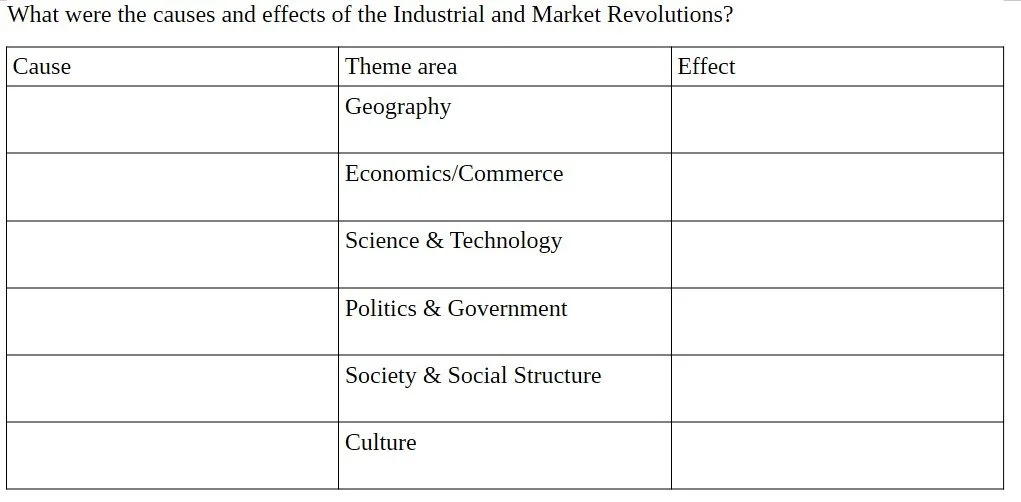
4) To finish class, broaden these concepts to include the rest of the Northern States and compare with the Southern States in the same era. This exercise should help students refine their thoughts about the inquiry.
Helpful secondary sources for class 2:
Timeline of New Hampshire History, NH Historical Society
Class 3: Use Primary Sources to learn Terms and People to Know and develop a response to the inquiry, Why did (theme) changes in New Hampshire take place, leading up to the Civil War?
Use the standard lesson plan for this class, pulling from the vocabulary that was established during class 1. Follow this sequence:
1) Evaluate a primary source of the teacher’s choice as a class (20 minutes)
2) Assign pairs of students a vocabulary term pertaining to the years 1815-1860 from the Terms and People to Know list. Students will use reliable collections to find primary sources that relate to the term or name, and then analyze the primary source using the PSA form. (20 minutes)
3) Students will add their findings to the database in the same row as their term or name. (5 minutes)
4) Individually, students will select a primary source from the list and then analyze it themselves. This will ensure a strong response on HW 4.1. (Remainder of the class)
Students should turn to the primary sources they wrote down on their SSE forms during class 2, but also look to this link for more.
Class 4: Demonstrate competency with homework and a quiz; Begin addressing second inquiry, How did (theme) transform NH after the Civil War?
A standard lesson plan for this class:
1) Students take their choice of quiz on reverse side of HW 4.1, and turn paper into teacher for grading (20 minutes)
2) Prepare HW 4.2 and set aside (5 minutes)
3) View/Listen to documentary and/or audio segments; take notes on a SSE form
Suggested viewing:
NH PBS “New Hampshire And the Civil War”
Recommended NHPR audio:
“The Bookshelf: The Civil War Diary of Freeman Colby”
“Recounting The Civil War Through Letters”
4) Students report out what they took notes on to groups (5 minutes), and groups report out to the rest of the class (5-10 minutes)
The secondary source column of the database/bibliography should be updated with the video/audio citation by the end of the class (5 minutes)
Class 5: Use Secondary Sources to learn Terms and People to Know and develop a response to the inquiry, How did (theme) transform NH after the Civil War?
1) Turn back and go over quizzes from last class (20 minutes)
2) Give students access to this infographic from NHHS’s Moose on the Loose curriculum
and/or
Send them to explore these data sets from the NH Department of Economic Development.
Have students complete an SSE form for the collection and presentation of data, focusing on the years 1860-1900 as well as their theme for the unit. (20 minutes)
3) Based solely on the data sets that were investigated and interpreted, assign each group to make a hypothesis about how their theme transformed after the Civil War. (10 minutes)
4) Finally, using trusted secondary sources such as NHHS’s timeline, have students test their hypothesis against fuller information such as narratives and the use of primary sources. (Remainder of the period)
Recommended secondary sources for class 5:
Timeline of New Hampshire History, NH Historical Society
Class 6: Use Primary Sources to learn Terms and People to Know and develop a response to the inquiry, How did (theme) transform NH after the Civil War?
This primary source day will focus on recreation and leisure sites that came into being during the late 19th and early 20th centuries. Just as has been done in previous units, the class is encouraged to use reliable secondary sources to complete all the questions on their primary source forms.
1) & 2) Follow the usual format to a primary source-centric lessons, the class will select a subject from the list to analyze as a class, and then choose additional subjects for groups and individuals to analyze from what remains.
Mount Washington Cog Railway, Thompson and Meserve’s Purchase, 1869
Wentworth by the Sea, New Castle, 1874
Camp Chocorua, Tamworth, 1881
Burgett Park, Dover/Somersworth, 1890
Hampton Beach Casino, 1899
Canobie Lake Park, Salem, 1902
Mount Washington Hotel, Bretton Woods, 1902
(feel free to add to the list with any other local recreation/leisure sites from the era).
3) As a different way to synthesize, groups should create a print advertisement for their selected subject, formatting it to appeal to the main patron demographic and in the style of the time period. They will share their work by the end of the period.
Class 7: Summative Assessment Day I: Graded Discussion and Project Design
1) Facilitate a graded discussion using student-made questions (30-40 minutes)
2) Assign group/class project. Give the students the remainder of the class period to work on it.
3) Students will turn in HW 4.2 at the end of class or have it checked while working on the project.
Class 8: Summative Assessment Day II: Project Presentation and Unit Test
1) Allow class members to put finishing touches on project(s)(15 minutes).
2) Share results (10 minutes)
3) Administer Unit Test (remainder of class)
The following links connect to secondary sources and primary source repositories created and maintained by other educators, historians, and institutions. I do not claim ownership of these materials. Instead, I share them as recommendations based on what has proven meaningful and effective in my own classroom experience. Teachers are invited to explore and adapt these resources to best meet their students’ needs, and encouraged to align with district expectations and protocols for using outside resources.
Website Timeline of New Hampshire History, NH Historical Society
Exploring this timeline is a great activity for classes 1, 2, and 5. Each entry has an easy-to-navigate list of facts regarding the entry, and many lead to primary sources.Website NH Historical Society Collections Catalogue
Staying with the NHHS site, this part of it can find usage on primary source investigation days. The advanced search feature helps keep results in the time frame you wish to stay in, and you can adjust the settings of what kinds of catalogue entries you want to see. It should be pointed out that the NHHS was founded during this time period—1823, the bicentennial of the state as a colony—and several local historical societies were established in the 19th century, too. Look to your town or city’s historical society to find out its founding (primary source) and see what secondary and primary sources they have regarding the 19th century.
Website New Hampshire’s Historical Highway Markers
Similar to the Timeline found on the NHHS page, this easy-to-use site can help start the unit. Students can explore the signs by list or by map, recognizing different terms and names as well as recognizing where things took place and when.
Website / Video Collections NH PBS’s Granite State History Minute
In conjunction with the New Hampshire Historical Society and other interested institutions, NH PBS has produced a series of minute-long videos explaining topics in the state’s past. There are several about the topics from this unit to be found, and they work great for class starters or independent/small group secondary source research.
Primary Sources New Hampshire State Archives
The Secretary of State’s office oversees the State Archives and has several set aside specifically as teacher resources. There are many more, of course, stored physically in Concord, but the curated pieces offer easy access for you and your students.
Short Video American Battlefield Trust “New Hampshire in the Civil War.” This short video from 2019 reviews the facts and figures of NH and its contributions to the Civil War.
Video NH PBS “New Hampshire And the Civil War”
Fritz Wetherbee presents this documentary which is designed to be an extension of Ken Burns’s The Civil War . There is a nice collection of vignettes from around the state, mostly about lesser-known moments and figures of the time period.
Short Audio Segments NHPR
These segments speak to New Hampshire’s involvement in the Civil War:
“The Bookshelf: The Civil War Diary of Freeman Colby”
“Recounting The Civil War Through Letters”
It may be worthwhile to ask students why letters and diaries are commonly used primary sources from that era.
Website/Articles/ EssaysSeacoastNH.com
Noted Portsmouth historian J. Dennis Robinson’s web presence contains numerous articles and essays about Seacoast History.
Website/Articles/Resources Black Heritage Trail New Hampshire
Though this project began on the Seacoast, it has since encompassed the entire state. Similar to the historic highway markers, the placement of signs are a great starting point to investigate themes and topics related to the time period further.
Website Historic Houses section of Strawbery Banke Museum’s Website
Each house at Strawbery Banke is correct to a different time period in the neighborhood’s past. The majority of the houses in the neighborhood were built in the time period you are studying now, with the Chase House, Rider-Wood Home, and Goodwin Mansion standing out as important sites for the era.